
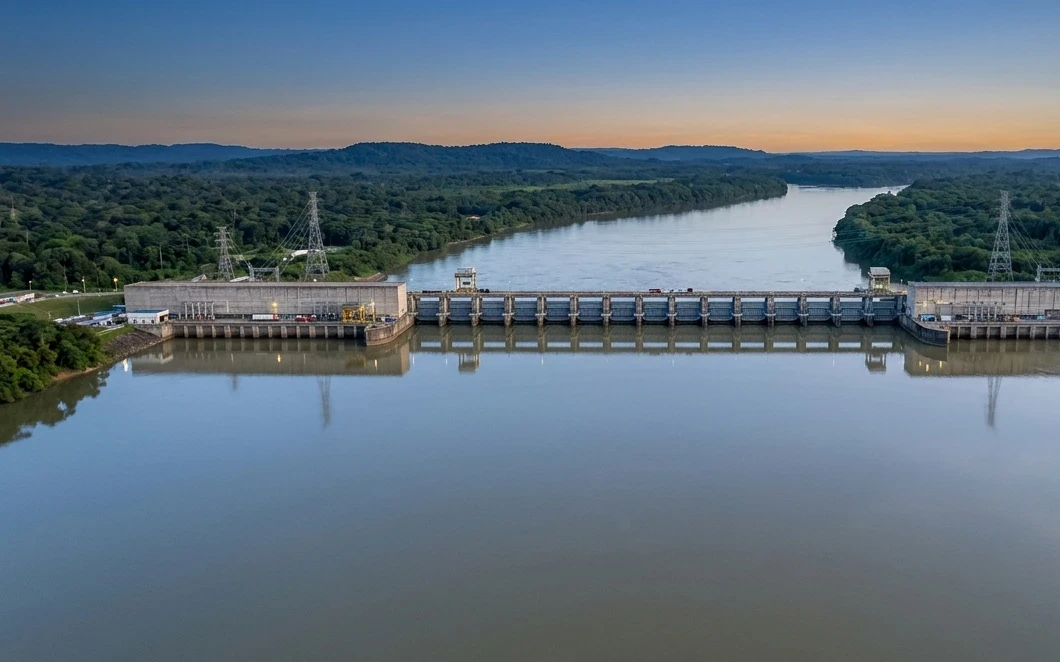
Daily Dispatch Optimization for a Large Hydropower Plant
Introduction
Every day, the plant must decide which of its 50 generating units will run, and at what power level, for each half hour of the following day. This schedule is sent to the National Grid Operator (ONS) and must respect a demanding set of hydraulic, electrical and environmental rules: two powerhouses with different characteristics, strict limits on reservoir level variation (2 cm per hour and 30 cm per day), river inflows ranging from 3,000 to 50,000 m³/s over the year, and head losses caused by debris at the water intakes. In recent years, the ONS has also frequently requested generation cuts during peak solar hours, forcing the plant to negotiate alternative schedules.
Before the project, the schedule was built in spreadsheets using simplified calculations, such as constant efficiencies and no generator or transformer losses. Every day, planners copied data by hand from several internal systems and e-mails, with no automated validation. Producing a single approximate plan took more than 40 minutes, leaving little room to evaluate alternatives or support negotiations with the ONS.
Methodology
Within an R&D project regulated by ANEEL (the Brazilian electricity regulator), Mip Wise led the development of PDOtimo, a decision support system that brings a mathematical optimization model, developed together with academic research partners (LabPlan-UFSC), into the plant’s daily planning routine. The project followed these phases:
- Discovery and process mapping: Mapping of the daily scheduling routine, data sources, and operating rules with the energy planning team, including minimum units per powerhouse, electrical safety logics, proportional dispatch, and powerhouse prioritization.
- Modeling and solution strategy: A Mixed-Integer Linear Programming (MILP) model represents the production function of each unit, hydraulic efficiency, hydraulic, generator, and transformer losses, and reservoir limits. A two-stage decomposition first defines the best reservoir trajectory for the day and then computes a detailed dispatch for each of the 48 half-hour periods, solved with the open-source SCIP solver.
- Data pipeline and validation: A formal data contract with validation at three levels (data types, business rules, and referential integrity) protects the model from inconsistent inputs. Hydrology, trashrack head losses, spillway status and maintenance data are ingested automatically from the plant’s corporate systems, with a spreadsheet upload kept as a fallback.
- Agile co-design: An early web prototype was refined through continuous feedback cycles with the planners, ensuring the final workflow (data, parameters, execution, results and ONS comparison) matched their actual daily routine.
- Deployment and handover: The production platform combines a React frontend, a .NET orchestration layer with asynchronous jobs and corporate authentication, and the Python optimization engine as an internal service, deployed with Docker on the client’s on-premises infrastructure. Technical and user documentation supported the handover to the client’s teams.
Results
PDOtimo is in production at Jirau, where it has replaced the spreadsheet-based process for daily dispatch scheduling.
- Operational efficiency: The time to produce a daily dispatch plan dropped from more than 40 minutes to less than 5 minutes, a reduction of more than 87.5% in manual work. Planners now run and compare several dispatch strategies on the same day instead of a single approximate plan.
- More energy from the same water: For the same operating day, the optimized schedule delivered 2.2% more average generation than the spreadsheet plan, while accounting for losses that were previously ignored. Letting the model also optimize the reservoir trajectory added between 0.8% and 1.7% of average generation in the scenarios evaluated.
- Stronger position with the ONS: The system automatically generates the schedule file required by the ONS and compares it with the operator’s counter-proposal. In a real scenario, an alternative schedule that shifted generation away from peak solar hours avoided all spillage and delivered 36.4 MW of additional average generation compared with the schedule requested by the ONS.
- Data reliability and traceability: Automated validation at every step reduces input errors, and every action is tracked at the user level, allowing several planners to work on scenarios at the same time.
Facing a similar challenge?
Every operation has its own constraints. Tell us what you have in mind and we will talk about what could be done in your case, with no obligation.