
AI-Driven Predictive Quality Engine
Introduction
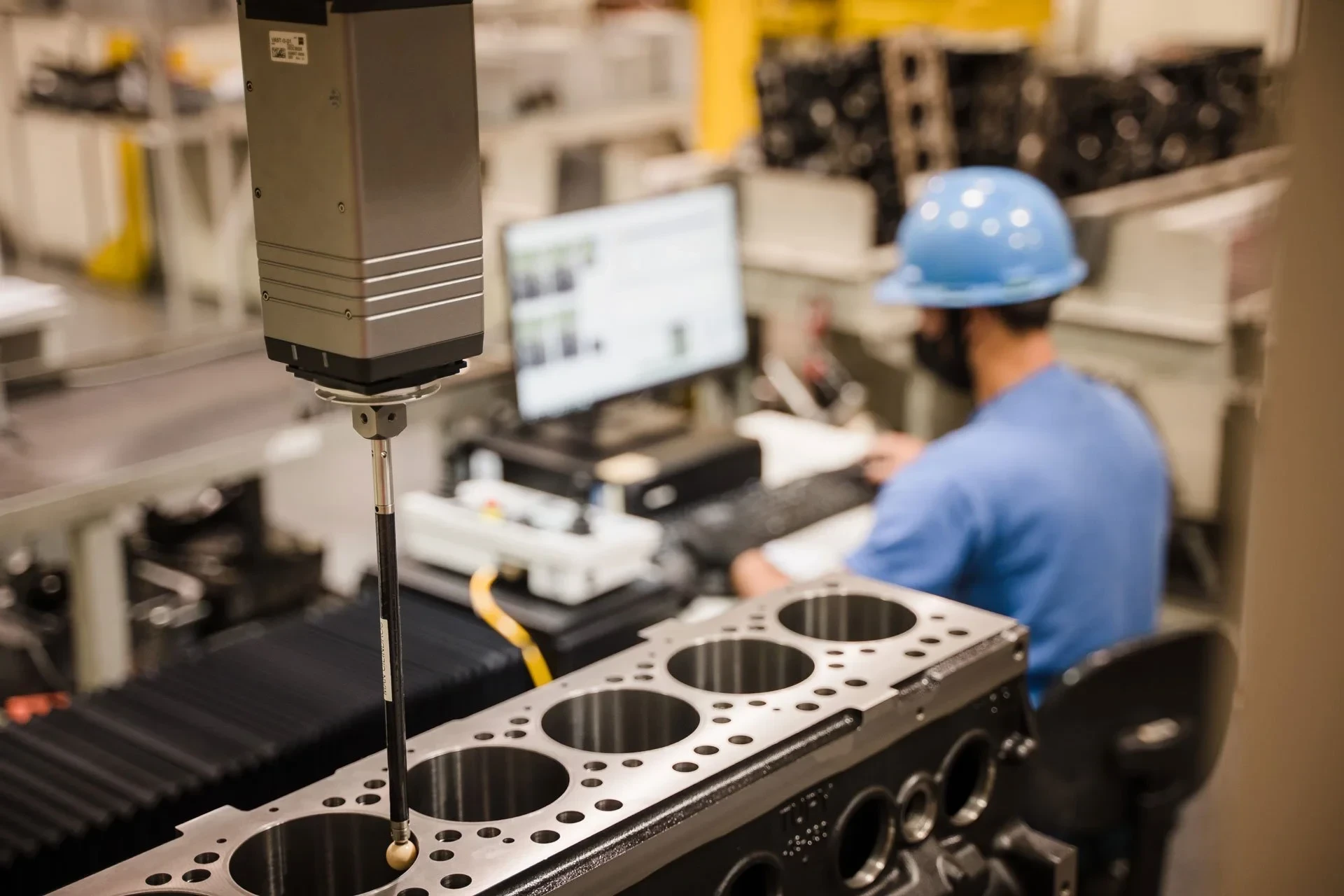
The client faced the challenge of ensuring the quality of its products (blocks and cylinder heads) through rigorous mechanical property testing. Currently, measuring properties such as hardness and traction is a slow and costly process, often involving destructive laboratory tests.
Because these mechanical properties result from a complex interplay between the metal alloy’s chemical composition and various manufacturing process parameters, the company sought an automated way to predict these outcomes. The objective was to achieve early identification of non-conformities, allowing for corrections in time to reduce the need for physical testing.
Methodology
The project was executed as a POC focusing on the development of machine learning models to predict properties across the production line. The methodology followed these key phases:
- Discovery and material selection: the team initially analyzed various materials, ultimately selecting a critical material that provided a higher volume of data and a significant history of test rejections to ensure model robustness.
- Data sanitization and preparation: data was curated from the client’s platform, involving the cleaning of chemical analysis, thermal analysis and casting parameters. This phase handled missing values, incorrect zeros in variables like temperature or demolding time, and association problems where lots were linked to inconsistent compositions.
- Exploratory data analysis (EDA): we performed an exhaustive analysis of 30 process variables and 17 mechanical tests. This included evaluating Spearman correlations to identify multicollinearity between features and their relationship with mechanical targets.
- Modeling and feature engineering: after testing complex models like Random Forests and Neural Networks, Ridge regression was selected for its superior performance on the specific dataset. We developed custom features, including estimated physical properties and quadratic polynomial features to capture non-linear patterns.
- Feature selection: a sophisticated selection process was implemented using Forward Feature Selection (FFS) and Backward Feature Selection (BFS), optimizing the model for each of the 17 mechanical characteristics.
- Deployment: the solution was delivered as an encapsulated, versioned Python package with both a Command Line Interface (CLI) and a Python API.
Results
The project successfully mapped the technical boundaries of predictive quality within the company’s casting process, providing a strategic tool for innovation. The delivered AI model is capable of predicting 17 different mechanical characteristics (hardness and traction) from casting and chemical data.
Facing a similar challenge?
Every operation has its own constraints. Tell us what you have in mind and we will talk about what could be done in your case, with no obligation.