
Shop floor rules
People who only do certain tasks, steps that follow an order, tools that several tasks share. Building by hand a plan that respects these rules takes hours, even for experienced planners.

Production scheduling
Mip Planner proposes the production schedule with the shop floor's rules and uncertainty already taken into account. The planner reviews and approves. Want to know how?
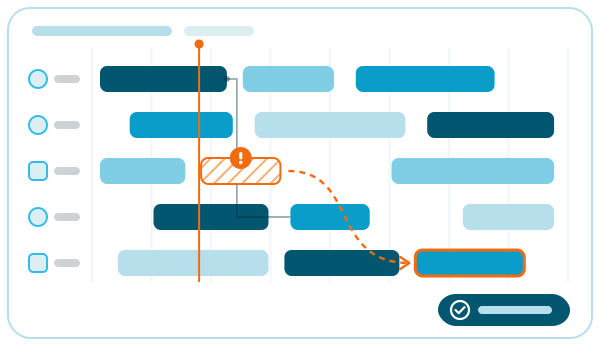
Drive off without checking traffic and you detour at every jam. With a GPS, the route is thought out before you leave. In production scheduling, the detour usually comes later, with the plan already running.
People who only do certain tasks, steps that follow an order, tools that several tasks share. Building by hand a plan that respects these rules takes hours, even for experienced planners.

A machine stops, a component is late, someone is absent. The plan that took hours to close has to be redone mid-week.

Deadlines of priority orders, equipment use, production cost. Balancing these criteria with every new version of the plan rarely fits in a spreadsheet.
Mip Planner
The plan comes from a mathematical model of your operation. These rules are part of the starting model, and whatever is specific to your factory goes into the fitting.

Precedence between steps, tasks that run to the end once started, and assignments already set, which the plan keeps.

People by skill and availability, components in stock over time, and shared tools in limited quantity.

More tasks finished, shorter total production time and priority for orders with tight deadlines, in a plan that takes adjustments without losing direction.

A mathematical model of your operation, with the rules and goals your team uses to schedule.

A combination of algorithms looks for a better schedule among the many possible ones, also when the data changes.

Who does each task, with which tool and when, in views by task and by person. The planner reviews, adjusts and approves.

Data comes in from the systems the factory already uses, and the approved plan goes back to them.

Production limits show up earlier, and the team plans around them.

When something changes, the planner asks for a new version of the plan and chooses the adjustment.

The schedule aims to finish more tasks on time with the resources the factory already has.

The most experienced people take the most critical tasks, and each person works on what matches their skills.
Contact
Book a call, no obligation and no sales pitch. We start by understanding how your team schedules today.

Aster Santana
CEO · Sr. Decision Scientist